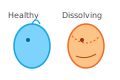
Ocean pH is still above 7 (basic) — but it is becoming less basic as the sea absorbs CO₂.
—
The Keeling Curve — the atmosphere changing the ocean
Carbon dioxide in the air at Mauna Loa, Hawaii, measured since 1958 (annual means for complete years). The ocean absorbs about 30% of the CO₂ released into the atmosphere, and in seawater it forms carbonic acid (NOAA).
Measured ocean pH off Hawaii since 1988
Surface seawater pH at Station ALOHA, north of Oʻahu, from the Hawaii Ocean Time-series. Dots: each research cruise; line: yearly average. Lower pH means more acidic.
Ocean pH scale
Mauna Loa CO₂
—
ppm (latest daily)
Aragonite saturation off Hawaii
—
below 1, shells dissolve
pH trend off Hawaii
—
pH units per decade
What does acidification do to life?
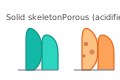
Pteropods: severe shell dissolution in these tiny sea snails has been found in the Southern Ocean (NOAA).
Corals: skeleton formation slows as aragonite becomes harder to pull from seawater.
Oyster hatcheries: at an Oregon hatchery, oyster larvae did worse when the upwelled seawater carried more CO₂ (Barton et al. 2012).
Is seawater getting harder for shell builders?
Aragonite saturation at Station ALOHA, yearly average. Corals, oysters and pteropods build shells and skeletons from aragonite; the lower the saturation, the harder that is, and below 1 the mineral starts to dissolve.
How much more by the end of the century?
Projected fall in global surface ocean pH from 1870–1899 to 2080–2099 (IPCC AR6, from climate models). For comparison, pH off Hawaii fell by about 0.07 between 1989 and 2024.
What drives this
Climate pollution →Human CO₂ emissions raise the atmospheric concentration the ocean absorbs.
Ocean heat →Warming and chemistry interact: heat stresses ecosystems while CO₂ changes carbonate balance.
What this drives
Coral bleaching →Acidification weakens reef building while heat drives bleaching.
Food systems →Shellfish and fisheries are part of the same climate-food risk chain.
How we know this
Source: NOAA GML Mauna Loa CO₂; Hawaii Ocean Time-series surface CO₂ data from Station ALOHA (J.E. Dore, University of Hawaiʻi; Dore et al. 2009); projections from IPCC AR6.
Update cadence: CO₂ is downloaded every night. The Station ALOHA file is updated about once a year (latest update 1 January 2026, with cruises through December 2024); we check it every night.
Time coverage: CO₂ since 1958; Station ALOHA since October 1988, about monthly.
Methods: pH at sea temperature, calculated by the Hawaii Ocean Time-series from measured dissolved inorganic carbon and alkalinity (continuous since 1988); pH measured directly since 1992 gives the same trend. Trends are straight-line fits over all cruises.
Uncertainty: One station in the open subtropical Pacific. Coastal waters, upwelling regions and polar seas acidify differently.
Limitations: The ocean is still basic (pH above 7); “acidification” means it is becoming less basic. Impact icons are illustrations.